Does Dairy Cause Acne? What the Research Really Shows
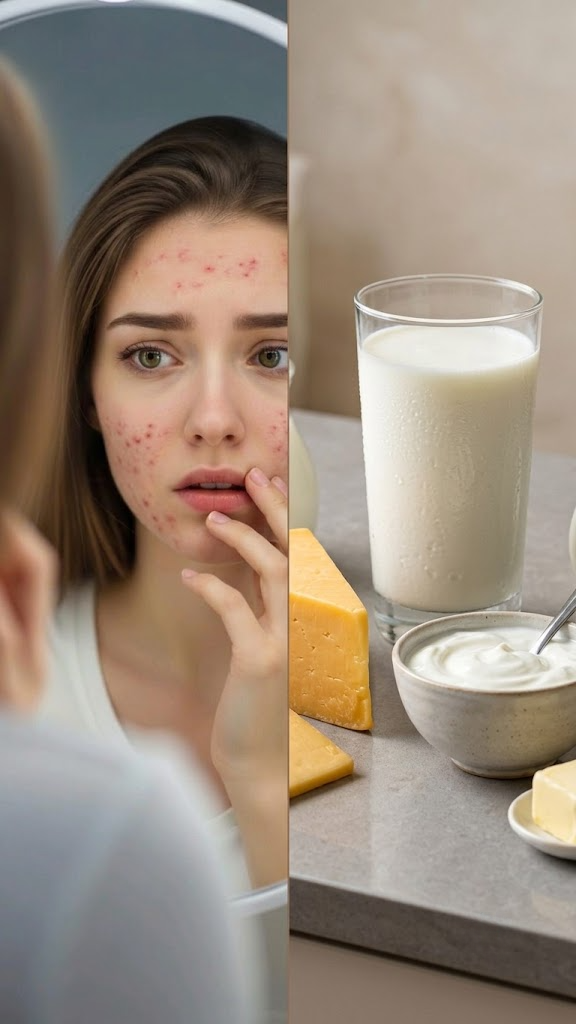
Does dairy cause acne? The short answer is: it may play a role for some people, but dairy does not cause acne in everyone.
Research has found a more noticeable link between acne and milk than with some other dairy foods. But a link doesn’t automatically mean that milk is the direct cause of breakouts.
Your hormones, genetics, skin type, diet, stress, sleep, and skincare routine can all affect acne too.
So should you stop eating all dairy?
Not necessarily.
If you think dairy is affecting your skin, it makes more sense to look at your main dairy sources and test them one at a time.
TABLE OF CONTENTS
- Does Dairy Cause Acne? The Short Answer
- How Does Dairy Cause Acne?
- Does Milk Have a Stronger Link to Acne?
- Does Cooked Dairy Cause Acne?
- Does Lactose or Dairy Cause Acne?
- Does Dairy Cause Acne in Adults?
- Does Dairy Cause Acne in Females?
- Does Dairy Cause Acne in Men?
- Does Dairy and Gluten Cause Acne?
- What About Greek Yogurt?
- Do Eggs Cause Acne?
- Does Whey Protein Cause Acne?
- How to Test Dairy as a Personal Acne Trigger
- Dairy and Acne: Quick Comparison
- Frequently Asked Questions
- Key Takeaway
Does Dairy Products Cause Acne? The Short Answer
Dairy may contribute to acne in some people, especially when it comes to milk, but the evidence does not show that all dairy causes acne.
A 2018 meta-analysis of 13 observational studies found a modest association between milk consumption and acne. The association was somewhat stronger for skim milk than for whole milk.
That still doesn’t prove that milk causes acne.
Another systematic review and meta-analysis involving more than 78,000 young people found associations between acne and several dairy foods, including milk, yogurt, and cheese. However, the researchers also noted differences between studies and possible publication bias.
The American Academy of Dermatology also describes the evidence as suggestive rather than conclusive.
So the most accurate way to put it is:
Some dairy foods may be linked with acne, with milk showing one of the more consistent associations. But dairy is not a universal acne trigger.
That distinction matters.
https://www.youtube.com/watch?v=eHgtTIHCumA
How Does Dairy Actually Cause Acne?
Researchers have suggested several ways dairy might influence acne.
The main areas of interest include insulin, IGF-1, androgen signaling, sebum production, and inflammation.
But these are possible mechanisms, not proof that dairy causes acne in a particular person.
Dairy, Insulin, and IGF-1
Milk contains proteins and other compounds that can affect metabolic and hormonal signaling.
Researchers have paid particular attention to IGF-1 (insulin-like growth factor 1).
IGF-1 is involved in growth and metabolism. It also interacts with pathways linked to oil production and acne development.
Insulin may influence some of these same pathways.
This gives researchers a possible explanation for the dairy-acne connection.
But a possible biological pathway doesn’t mean that everyone who drinks milk will develop pimples.
Why Is Milk Studied More Than Other Dairy?
Milk has received more attention in acne research than most other dairy foods.
One reason may simply be how much people consume.
Someone might drink milk every day, while eating cheese or yogurt less frequently.
Studies have also reported different associations for skim, low-fat, and whole milk.
However, this does not mean skim milk has been proven to cause more acne.
It means that observational studies have found a stronger association with skim milk.
Does Milk Have a Stronger Link to Acne?
Yes. Milk has one of the clearest and most frequently reported associations with acne among dairy foods.
In the 2018 meta-analysis, researchers looked at data from more than 71,000 participants.
Milk consumption was associated with a modestly higher likelihood of acne. The association was somewhat stronger for skim milk.
The American Academy of Dermatology also discusses research linking cow’s milk with acne in different groups, including adolescents and young adults.
But there is an important limitation.
Most of this research is observational.
That means researchers can see that two things occur together, but they can’t always tell whether one directly caused the other.
People who drink more milk may also differ in their overall diet, lifestyle, age, or other factors.
So milk is worth considering if you’re trying to identify a personal acne trigger.
It shouldn’t automatically be labeled the cause.
Does Cooked Dairy Cause Acne?

Cooking dairy doesn’t automatically make it either acne-causing or acne-safe.
The type and amount of dairy may matter more than whether it has been heated.
For example, these aren’t the same exposure:
- A small amount of milk in a recipe
- A splash of milk in coffee
- A large latte every day
- Several glasses of milk
- A milkshake
- A daily whey protein shake
If you’re testing dairy as a possible trigger, focus on the largest and most consistent source first.
There’s no need to become worried about tiny amounts of cooked dairy in every meal.
Does Lactose or Dairy Cause Acne?
Lactose intolerance and dairy-related acne are two different things.
Lactose is the natural sugar found in milk.
People with lactose intolerance may experience symptoms such as:
- Bloating
- Gas
- Abdominal discomfort
- Diarrhea
Acne is a separate condition.
Research into dairy and acne has focused more on milk and its biological components than on lactose intolerance itself.
This means that switching to lactose-free milk doesn’t necessarily remove every component of milk that researchers are studying.
So if you suspect dairy affects your skin, don’t assume lactose is automatically the problem.
Does Dairy Cause Acne in Adults?
Dairy may be one factor in adult acne, but adult breakouts usually have more than one possible trigger.
Adult acne can be influenced by:
- Hormonal changes
- Genetics
- Stress
- Sleep
- Skincare products
- Certain medications
- Menstrual changes
- Diet
- Environmental factors
That’s why one breakout after drinking milk isn’t enough to prove anything.
A repeated pattern is much more useful.
For example, suppose you drink several servings of milk every day.
If your acne repeatedly becomes worse during periods of higher milk intake and improves when that intake changes, dairy becomes a reasonable factor to investigate.
It still doesn’t prove that dairy is the only cause.
Does Dairy Cause Acne in Females?
Dairy may contribute to acne in some women, but there isn’t enough evidence to say that women universally react to dairy differently.
This question can be especially confusing when hormonal acne is involved.
Some women notice breakouts around the:
- Chin
- Jawline
- Lower cheeks
These breakouts may also change around the menstrual cycle.
If your dairy intake changes at the same time as your hormones, stress, sleep, or skincare routine, it becomes difficult to identify one cause.
A simple food and skin diary can help.
Track your:
- Dairy intake
- Breakout location
- Menstrual cycle
- Sleep
- Stress
- Skincare products
- Major dietary changes
You may start to see a pattern that isn’t obvious from looking at your skin day by day.
Does Dairy Cause Acne in Men?
For men, whey protein deserves separate attention from ordinary dairy foods.
Whey comes from milk, but whey protein supplements provide a concentrated source of whey protein.
Some case reports and observational research have raised concerns about whey and acne.
However, controlled research has not produced a clear answer.
A 2024 randomized controlled trial followed 49 men with acne for six months. The researchers compared daily whey protein with a non-whey protein supplement and did not find a significant difference in acne severity or lesion counts.
So whey protein should not be described as a proven cause of acne.
If you’ve started using whey regularly and noticed changes in your skin around the same time, though, it may be worth testing separately from milk, yogurt, and cheese.
Does Dairy and Gluten Cause Acne?
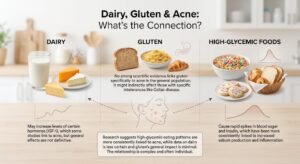
There isn’t strong evidence that gluten is a general acne trigger for most people.
This question often comes up when someone removes dairy and gluten at the same time and then notices clearer skin.
But think about what else may have changed.
Cutting dairy and gluten might also mean eating fewer:
- Pizza
- Pastries
- Sweetened cereals
- Desserts
- Fast food
- Refined carbohydrates
That makes it difficult to know what actually changed the skin.
Research has received more attention for high-glycemic eating patterns than for gluten as a general acne trigger.
So if you’re testing dairy, change dairy first.
Don’t remove five different food groups at once unless there is another reason to do so.
What About Greek Yogurt?
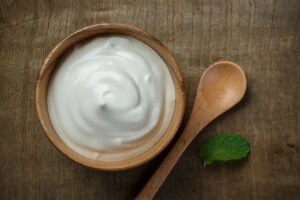
Greek yogurt is dairy, but its relationship with acne isn’t as clear as the milk research.
Some observational studies have reported an association between yogurt and acne.
Other research hasn’t found a clear relationship.
The American Academy of Dermatology currently notes that studies have not established yogurt or cheese as clear acne triggers.
So there’s no strong reason to assume that Greek yogurt automatically causes breakouts.
If you eat it regularly and suspect it affects your skin, you can test it as an individual food rather than treating all dairy as one category.
Do Eggs Cause Acne?
Eggs aren’t dairy, and there isn’t strong evidence that eggs are a general acne trigger.
This distinction is easy to miss.
Someone might eat eggs with cheese, drink a latte, and have a whey shake on the same day.
If a breakout appears afterward, it’s easy to blame eggs simply because they were part of the meal.
That’s why foods need to be considered separately when you’re trying to identify a personal trigger.
Does Whey Protein Cause Acne?
Whey protein may contribute to acne for some people, but the evidence is mixed.
Whey is different from ordinary dairy because it’s a concentrated milk-derived protein.
Some reports have described acne appearing or worsening after whey supplementation.
Other research has not found a clear causal relationship.
The 2024 controlled trial mentioned earlier also found no significant difference in acne outcomes between whey and non-whey protein supplementation.
So whey is best treated as a possible individual trigger, not a proven cause for everyone.
If your acne started or became noticeably worse after beginning a daily whey shake, that’s a useful pattern to investigate.
How to Test Dairy as a Personal Acne Trigger
If you genuinely want to know whether dairy affects your skin, change one major variable at a time.
You don’t need to completely change your diet overnight.
1. Start With Your Biggest Dairy Source
Look at what you consume most often.
If you drink milk several times a day, start with milk.
If you use a whey shake every day, whey may be the more relevant thing to test.
Don’t remove milk, cheese, yogurt, whey, eggs, gluten, and sugar all at once.
You’ll have no idea which change made a difference.
2. Give It Time
Acne doesn’t necessarily change within a few days.
A short break from milk isn’t enough to confidently say that dairy is or isn’t affecting your skin.
The American Academy of Dermatology recommends paying attention to what happens when you stop a suspected food or drink for a period of time, such as a day, week, or month.
Give your skin enough time to show a meaningful pattern.
3. Take Weekly Photos
Photos can be more useful than memory.
Take one photo each week using the same:
- Lighting
- Camera
- Angle
- Distance
Don’t check your skin repeatedly throughout the day.
Acne naturally changes from day to day, and frequent checking can make small fluctuations seem more significant than they are.
4. Track Other Acne Triggers
Keep a simple record of:
- Dairy intake
- Stress
- Sleep
- Menstrual cycle, if applicable
- Skincare products
- Medications
- Major dietary changes
This matters because acne rarely has one simple explanation.
You may discover that the pattern you blamed on dairy actually lines up more closely with another change.
5. Reintroduce the Food
If your skin improves after removing a suspected food, don’t immediately assume you’ve found the answer.
Bring the food back and observe what happens.
If the same pattern happens again, that gives you stronger personal evidence than one isolated breakout.
This isn’t a medical diagnostic test.
It is simply a practical way to investigate whether a particular food may be contributing to your acne.
Dairy and Acne: Quick Comparison
| Food | What research suggests | Confidence |
|---|---|---|
| Cow's milk | Associated with acne in observational research | Moderate |
| Skim milk | Association appears stronger in some studies | Moderate |
| Whole milk | Some association reported | Limited-moderate |
| Yogurt | Evidence inconsistent | Limited |
| Cheese | No consistent association | Limited |
| Whey protein | Some reports/studies suggest a possible link | Limited |
| Eggs | No strong established association | Limited |
The key point is that not all dairy foods should be treated the same way.
Milk has a stronger research signal than yogurt or cheese.
Whey is also worth considering separately because it is a concentrated milk-derived product.
Frequently Asked Questions
Does dairy cause acne for everyone?
No.
Research suggests that some dairy foods, particularly milk, may be associated with acne.
But many people consume dairy without experiencing noticeable changes in their skin.
Does dairy cause acne breakouts?
It may contribute to breakouts in some people.
Milk has one of the stronger research associations, but the evidence does not prove that dairy causes acne in everyone.
How does dairy cause acne?
Researchers have proposed pathways involving insulin, IGF-1, androgen signaling, sebum production, and inflammation.
These mechanisms are biologically plausible, but they don’t prove that dairy causes acne in every person.
Does cooked dairy cause acne?
Not necessarily.
Cooking doesn’t automatically make dairy acne-causing or acne-safe.
The type and amount of dairy are more useful factors to consider.
Does lactose or dairy cause acne?
Lactose intolerance and acne are different issues.
Research into dairy and acne has focused more on milk and its biological components than on lactose intolerance itself.
Does dairy cause acne in adults?
It may be one factor.
But adult acne can also involve hormones, genetics, stress, skincare products, medications, sleep, and other factors.
Does dairy cause acne in females?
It may contribute to acne in some women.
However, there isn’t enough evidence to say that women universally respond differently to dairy.
Hormonal fluctuations can also make acne patterns more difficult to interpret.
Does dairy cause acne in men?
It may be a factor for some men.
Whey protein is particularly worth considering if you’re using it regularly, although research on whey and acne remains mixed.
Does dairy and gluten cause acne?
There isn’t strong evidence that gluten is a general acne trigger.
Some research has focused instead on high-glycemic eating patterns.
If you’re testing dairy, change one thing at a time so you can identify what actually affects your skin.
Does Greek yogurt cause acne?
The evidence isn’t clear enough to say that Greek yogurt causes acne.
Some studies have reported associations with yogurt, while other evidence hasn’t established a clear connection.
Does whey protein cause acne?
Possibly for some people.
However, controlled research has produced mixed findings.
Whey is better viewed as a possible individual trigger rather than a proven cause of acne.
Key Takeaway
Does dairy cause acne? It can be a factor for some people, but the evidence does not support saying that all dairy causes acne.
Milk has one of the stronger research associations with acne. The evidence for yogurt and cheese is less consistent, while whey protein deserves separate consideration because research on its relationship with acne is still mixed.
If you suspect dairy is affecting your skin, don’t automatically remove every dairy food from your diet.
- Start with the biggest source.
- Track your skin for several weeks.
- Keep other major variables as consistent as possible.
- Then reintroduce the food and see whether the same pattern returns.
- That gives you a much more useful answer than simply deciding that all dairy is bad for acne.



Post Comment